Summary
Between 40-90% of people in Australian prisons are believed to have an acquired brain injury (ABI). Despite this, people are not screened for brain injury, nor any type of disability when they enter prison.
Undiagnosed brain injury leads to higher rates of re-offending and increased challenges with navigating the criminal justice system (Alderman et al. 2018).
The Disability Royal Commission recommended in 2023 that all state and territory governments implement national practice guidelines for disability screening in custody, with a particular focus on early identification of cognitive disability including ABI.
Three years on, and Victorian Government has not implemented these.
Our ask:
1.All people who enter correctional services in Victoria have the opportunity to be screened for acquired brain injury, whether they are on remand or in custody.
2.Screening guidelines, practices and supports are culturally safe, trauma informed and developed in close partnership with lived experience and First Nations partners.
Identifying brain injury matters - in our words
Many people will not self-identify having an acquired brain injury (ABI) when they enter prison. And there are good reasons for that.
You don’t know what an ABI is. You haven’t even heard of it before. And you’re not going to trust staff with that kind of information either.
While the AIHW estimates that between 40 to 90 per cent of people in Australian prisons have ABIs, reported diagnoses falls well short of this figure by correction services across the country.
This is something that Corrections Victoria is aware of and has been since it commissioned its report on this in 2011 as part of its research paper series.
In our prisons, you’re expected to speak up on something you don’t know about. You’re expected to speak up on something that can make you vulnerable on what is already a traumatic day; the absolute worst day in your life.
There are real risks of openly identifying with having an ABI when you’re inside. There's a role you’ve got to play. Macho. Strong. Not weak.
And not disabled. For women with a disability, you’re made to feel a lesser person with an ABI. By the staff. By others inside. It’s risky and it has its challenges. So is universal screening and early identification worth it? It’s a turning point, and the truth is, you’re back to black if you don’t.
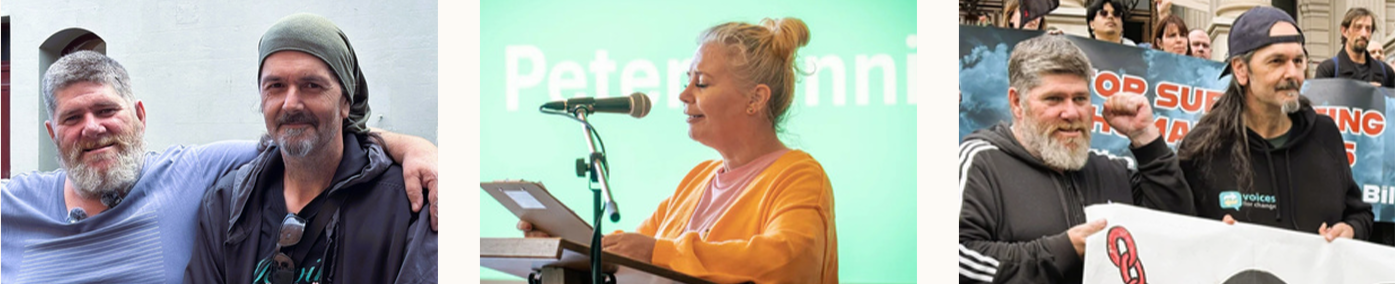
“I would hate to know what my life would be like if I hadn’t been diagnosed. It’s a big part of my life. I’d be losing the tools, the people, the friends, the understanding.” Francesca Lee
Once diagnosed, something clicks in your head. You learn to do things different. You start functioning again. You start to care. If you get the diagnosis during your time in prison, your chances of staying out of trouble on the outside are better.
“Before the diagnosis, I was on the merry-go-round. I’d been in and out of prison 12 to 14 times. Since being diagnosed over five years ago, I haven’t been back once. After that, I started functioning and I started caring for myself again.” Michael Mayne
Diagnosis can take months. Done on the inside, and you have a better chance of getting through all the hurdles and the getting support. Months inside and you’ve got the chance to rethink what’s happened. You start to rethink what is possible. You start to change the patterns while you’re in there.
“At first, I said to the doctor, nah you’re the one who needs help. But then someone listens and you get self knowledge and you start to care.” Michael Mayne
Through the diagnosis you get the chance to think back and make sense of what’s gone on. It’s then the support you start to receive to get to the appointments on time, to turn up when you need to and to hold down the house.
“I had a car accident and was left for dead. I knew I was different, but I’d never heard the word ABI. Not even in the hospital.” Francesca Lee “But I knew I wasn’t managing and wasn’t able to keep my job. A lot of things fell apart. It was a very hopeless and scary thing to feel.” Francesca Lee
After the diagnosis, it’s not just the support services you receive, but it’s the understanding and care you get from your friends. And it’s the friends you make who really care for you. You think about things more. It’s mindfulness, and it’s pausing.
We've got the responsibilities now, we take the time, we don’t jump to the asks of people who don’t love us. And importantly, we are not in jail.
“If you get to the appointments. If your routines are there. These things will help a lot. It certainly would have made a difference to me.” Matthew Pallaris
“I went in young. No one talked about it. I had no idea what an ABI was or what it meant.” Matthew Pallaris
The fact is, if you don’t get everyone screened, someone is going to get missed. And we, Corrections Victoria and the Disability Royal Commission all know - there are a lot of people in our prisons who are getting missed.
The fact is, if you ain’t got the support, you’re not going to make it. They suffer, and our community suffers. Old patterns and cycles continue, and they stay on the merry-go-round, in and out of prison
Let’s take action in Victoria this election. Let’s get everyone screened as soon as they’re off the truck. We’ve been in it. We know what comes with it.
Supporting data
Early identification of ABIs reduces entrenched cycles of offending and reincarceration among people in contact with the criminal justice, driving down pressure and contact on an increasingly over-extended justice system in Victoria (Saunders, Lansdell and Eirksson, 2025).
Recidivism remains an entrenched feature of the Victorian justice system, with almost 40 per cent of people released from prison returning within two years (Sentencing Advisory Council Victoria 2026).
As the Disability Royal Commission reported in 2023, prisoners with disability are more likely to have difficulty coping with the prison environment, are at increased risk of experiencing disadvantage in the community and have a notably higher risk of returning to custody upon release.
The Australian Institute of Health and Wellbeing (2025) estimates between 40-90% of people in Victorian prison have ABIs. A matter that Corrections Victoria has reported as substantially overrepresented since it commissioned research on the issue in 2011.
ABS June 2026 figures place imprisonment in Victoria at 132 prisoners per 100,000 adults, which currently looks like over 7,400 people in Victoria’s adult prisons.
Within the current climate, it is estimated that 3,000 people at minimum in custody or on remand in Victoria currently have an ABI. The vast majority of whom have not been effectively screened, identified, or received the diagnosis that they deserve and need.
It is estimated that rates of brain injury are up to three times higher for incarcerated First Nations people than for non-Indigenous people (Human Rights Watch 2018).
With early intervention and universal screening, we can get people the supports they deserve and need, reduce recidivism rates in Victoria, and deliver on government commitment to drive down repeat contact with our justice system.
Endorsed by: